

Guide Rail Cargo Lift 1000 kg, 3 m LiftSKU: TMB-GR1000-403347427
A single steel rail carries 1000 kg through 3 m between two floors — bolted to the wall, driven by a hydraulic cylinder on four chains, and worked from a remote handset so nobody stands under the load.
- ✓
Held in stock in the standard 1000 kg, 3 m build and dispatched from our own warehouse. A different lift height, platform size or finish is built to order — see custom options.
- ✓
Built to the specification published here — same single rail, four chains and hydraulic power unit on every unit we ship.
- ✓
Nothing ships until you approve the freight quote in writing.
- ✓
Packing list, commercial invoice and bill of lading sent with every shipment.
One rail on the wall, 1000 kg between floors
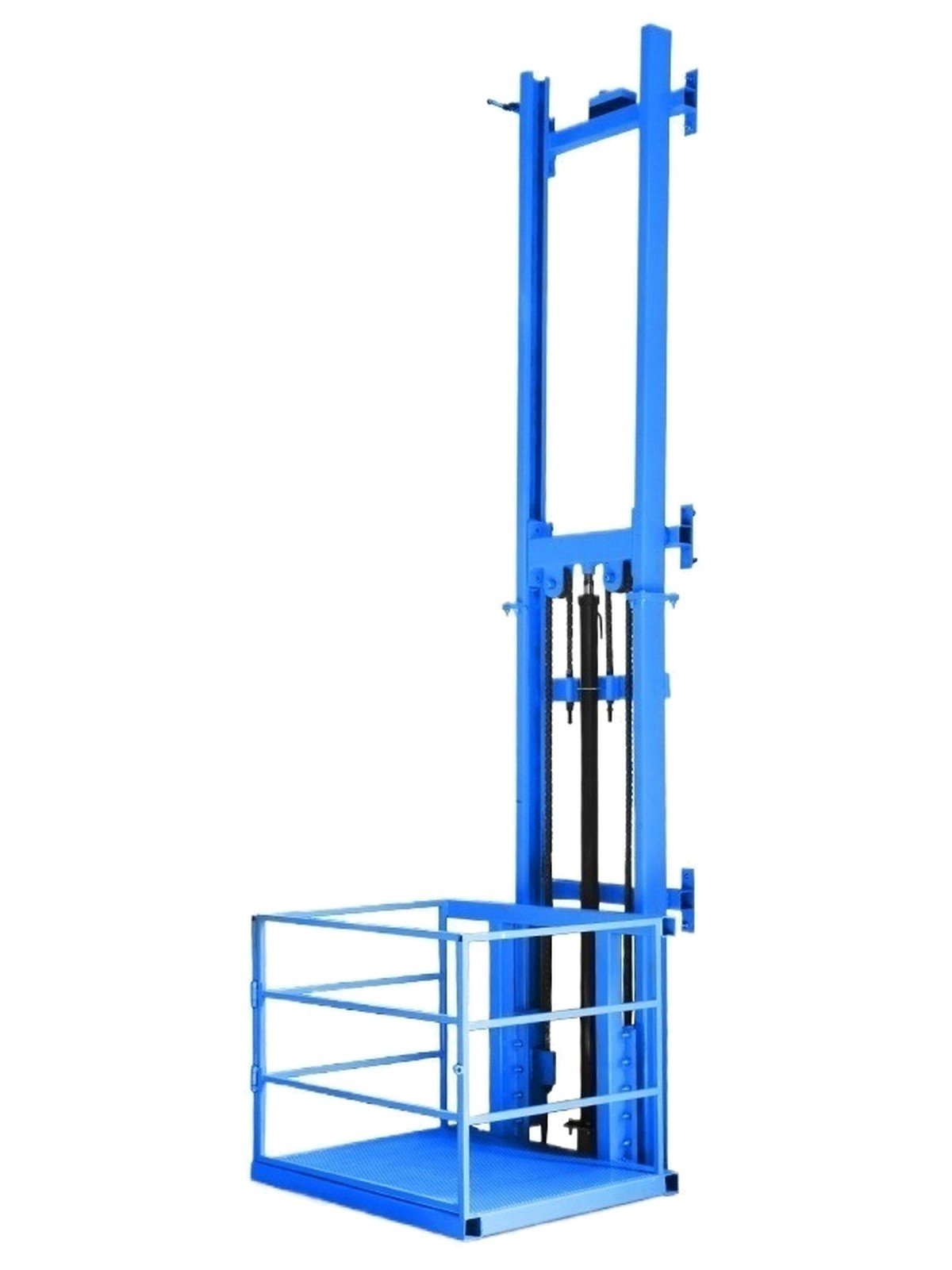
This is the lift you fit when a stair or a hoist will not take the weight and a full goods elevator will not fit. The rail bolts to the wall beside the opening, the platform runs up it, and the load goes from one floor to the next without anyone carrying it.
1000 kg on a single rail
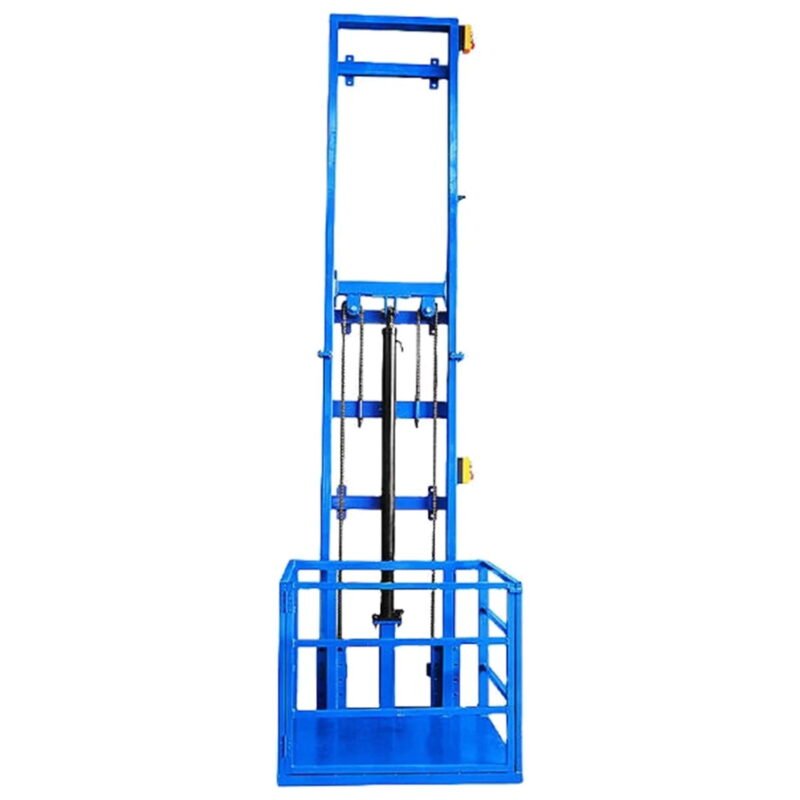
The platform hangs off one steel post on two guide channels, so the lift needs one wall line rather than a shaft. A tonne of goods — a pallet of stock, a crate, a stack of panels — goes up square instead of one corner at a time.
Hydraulic cylinder on four chains
A hydraulic cylinder lifts the platform through four chains running over pulleys at the top of the rail. Four points, not one, so the deck stays level and a load sitting off centre does not cock the platform in the guides.
Bolted to the wall, not a wheeled cart
Four brackets hold the rail to a wall or a structural column and carry the load into the building instead of into the floor. That is why a 400 kg machine can raise 1000 kg without ballast or a counterweight.
Remote handset and a limit switch
The platform is worked from a remote control handset, so the operator stands clear of the load instead of under it. A roller limit switch at the top of the rail stops the platform before it reaches the pulley.
Guide rail cargo lift: technical data
Figures are for the standard build. Send us the floor-to-floor height and the wall you intend to fix the rail to, and we confirm the rail length, the platform size and the fixing detail on a drawing before production.
Lifting & control
| Lifting mechanism | Single guide rail, hydraulic cylinder lifting the platform on four chains |
| Drive | Electric hydraulic power unit — motor, pump and oil tank on one base |
| Lift height | 3 m |
| Control | Remote control handset |
| Upper limit | Roller limit switch at the top of the rail |
| Power supply | Confirmed per destination on the quotation drawing |
Build
| Mast | One steel post, two guide channels, four wall-mounting brackets |
| Platform deck | Checkered anti-slip steel plate |
| Guard | Three-sided fence around the deck |
| Load capacity | 1000 kg |
| Machine weight | About 400 kg |
| Finish | Steel, red or blue |
| Installation | Fixed to a wall or structural column — not a mobile unit |
Manually measured dimensions may vary slightly; refer to the actual machine. Lift height, platform size and power supply for a specific build are confirmed on the quotation drawing.
What lifts the platform, and what holds it level
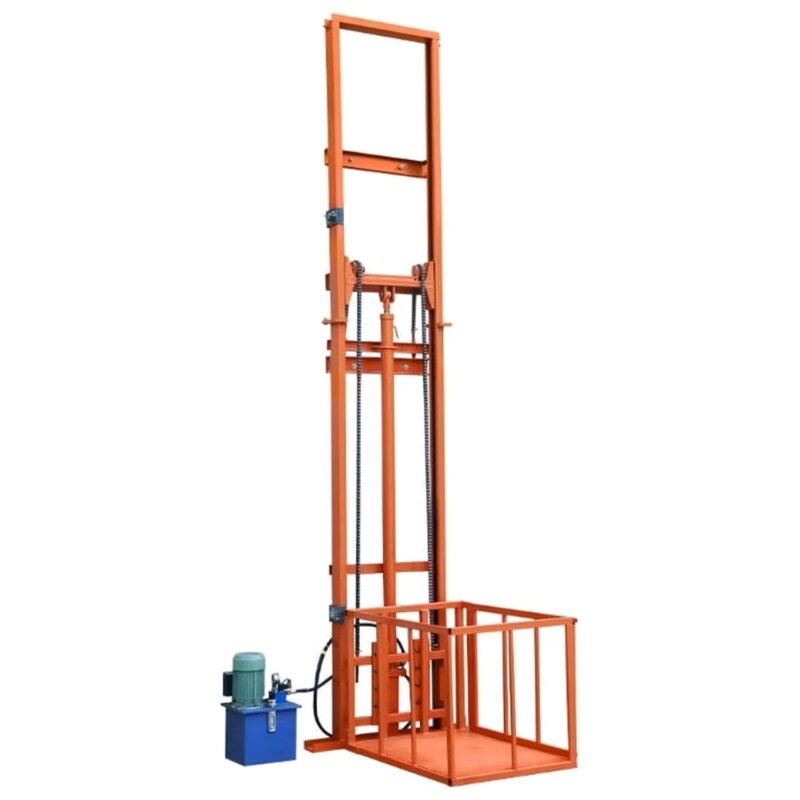
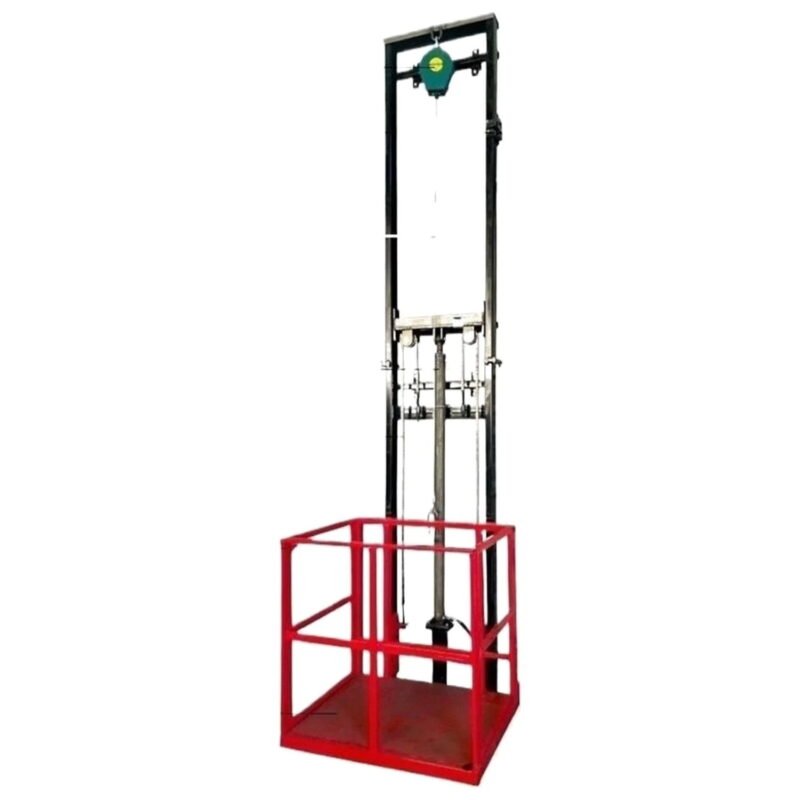
The same machine is shown here in both standard finishes, red and blue. The rail carries the load into the wall; the cylinder and the four chains do the lifting; the power unit sits on the floor beside it; the fence and the checkered deck keep the goods on the platform.
One cylinder in the middle of the rail
The hydraulic cylinder stands between the two guide channels and pushes the platform carriage straight up. Because the push is vertical, the rail takes it in compression — a 400 kg machine raises 1000 kg without a counterweight.
Four chains over two pulleys
Each side of the platform is carried by a pair of chains running over a pulley at the top of the rail. Four points hold the deck level, so a load sitting to one side does not jam the platform in the guides.
Checkered plate, not a sheet of plywood
The deck is checkered anti-slip steel, welded into a frame with a lip on the loading edge — a pallet or a drum sits on it without sliding as the platform starts and stops. The plate also takes a forklift or pallet truck nosing in at floor level.
Three sides fenced, one side open
The fence closes the back and both ends and runs in horizontal rails, so the goods stay on the deck while the loading side stays clear. The open side is the one that meets the floor you are loading from.
Motor, pump and tank on one base
The hydraulic power unit stands on the floor beside the rail: a vertical motor over a valve block and a pressure gauge, sitting on the oil tank. It is a separate unit, so it can be placed where there is room and reached for service without climbing to the platform.
The parts you touch are at floor level
Oil level, the pressure gauge and the valve block are all at the bottom of the installation, not at the top of the rail. Chains and the limit switch are the only parts that need checking at height, and both are reachable from the upper floor opening.
The openings where a stair is the only way up
A back-of-house lift for goods, not for passengers: it fits the wall line beside an existing opening, needs one power supply, and takes the weight that a stair, a ramp or a pair of hands will not.
- Mezzanine and second-floor stockA pallet or a stack of cartons goes from the ground floor to the mezzanine deck in one lift, instead of being broken down and carried up a stair a box at a time.
- Warehouse and workshop levelsBetween a production floor and a storage floor, or onto a loading dock at a different level — the platform takes the weight and the operator stays on the floor with the handset.
- Basement and back-of-house deliveriesStock arriving at street level goes down to a basement store through a stairwell opening, without a ramp or a goods elevator the building does not have.
- Shops, kitchens and small storeroomsWhere the volume is small but the weight is not — drums, crates, sacks and cases that one person should not be carrying up a flight of stairs every day.
Custom options on this guide rail lift
The 1000 kg build with 3 m of travel is the standard machine. When the floor-to-floor height is different or the platform has to take something wider, the same rail and cylinder are built to your drawing.
- Lift height3 m is standard. A taller rail is built for a higher floor — send the floor-to-floor height and the headroom above the upper opening.
- Platform sizeThe standard deck suits pallets and crates. A wider or longer platform is built for panels, drums or long goods, with the fence and the loading lip adjusted to match.
- Finish and your logoRed or blue as standard. A specified colour and your logo can be applied before the machine leaves the factory.
- Loading and unloadingA roller deck, a small ramp lip or a pallet-stop bar can be fitted to the loading edge so goods roll on and off instead of being lifted over the lip.
Freight is quoted separately and confirmed before dispatch
We ship worldwide by sea (LCL and FCL) and by air or express for sample orders. Freight is priced per destination because it depends on port, weight and volume — this lift ships as one crate on a pallet, rail and platform bundled separately.
-
You place the order online
Your order is recorded and the machine is reserved for you while the freight is quoted.
-
We send a freight quote in 24–48 hours
Priced to your nearest port, with transit time, or to your door as DDP if you prefer.
-
You confirm and pay the freight
One invoice for the shipping cost. Nothing is dispatched until you approve it.
-
We book, load and send documents
Packing list, commercial invoice and bill of lading go to your email, with photos of the packed goods.
Frequently asked questions
How high does it lift?
How much can it carry?
How is it installed?
How is it operated?
What stops it at the top?
What size is the platform?
Can people ride on it?
What does it cost, and how is freight worked out?
Other lifts for the same kind of job
Same factory and the same spare-parts support. Choose by what has to go up: goods only, a panel on its edge, or a person with the work.

Cold Storage Panel Lift 4.5 m
When the load is a flat panel rather than a crate: a single mast that holds a panel square while it goes up the wall.
View product →

Double Arm Electric Material Lift 400 kg
When the lift has to move to the work: two arms on a wheeled mast, 400 kg up to 4 m, pushed where it is needed.
View product →

Fixed Electric Scissor Lift Platform
When the lift point is inside a production line rather than at a wall: a 1300 × 820 mm platform, 305 to 1780 mm.
View product →
For fixed lifting installations used in general industry, see OSHA 29 CFR 1910.176 on materials handling and storage.

Reviews
There are no reviews yet.