
Double Arm Electric Material Lift 400 kg, 2.2 – 4 mSKU: TMB-DA400-405699843
Two horizontal arms on a 2.2 m two-post mast, raised to 4 m by a copper-motor electric hoist — so a length of pipe, a duct section or a coil goes up on the machine instead of on someone's shoulder.
- ✓
Held in stock in the standard 400 kg build and dispatched from our own warehouse. A different load rating, lift height, arm length, colour or logo is built to order — see custom options.
- ✓
Built to the specification published here — same two-post mast, four casters and copper-motor hoist on every unit we ship.
- ✓
Nothing ships until you approve the freight quote in writing.
- ✓
Packing list, commercial invoice and bill of lading sent with every shipment.
A pair of arms takes the load up the mast, not up a ladder
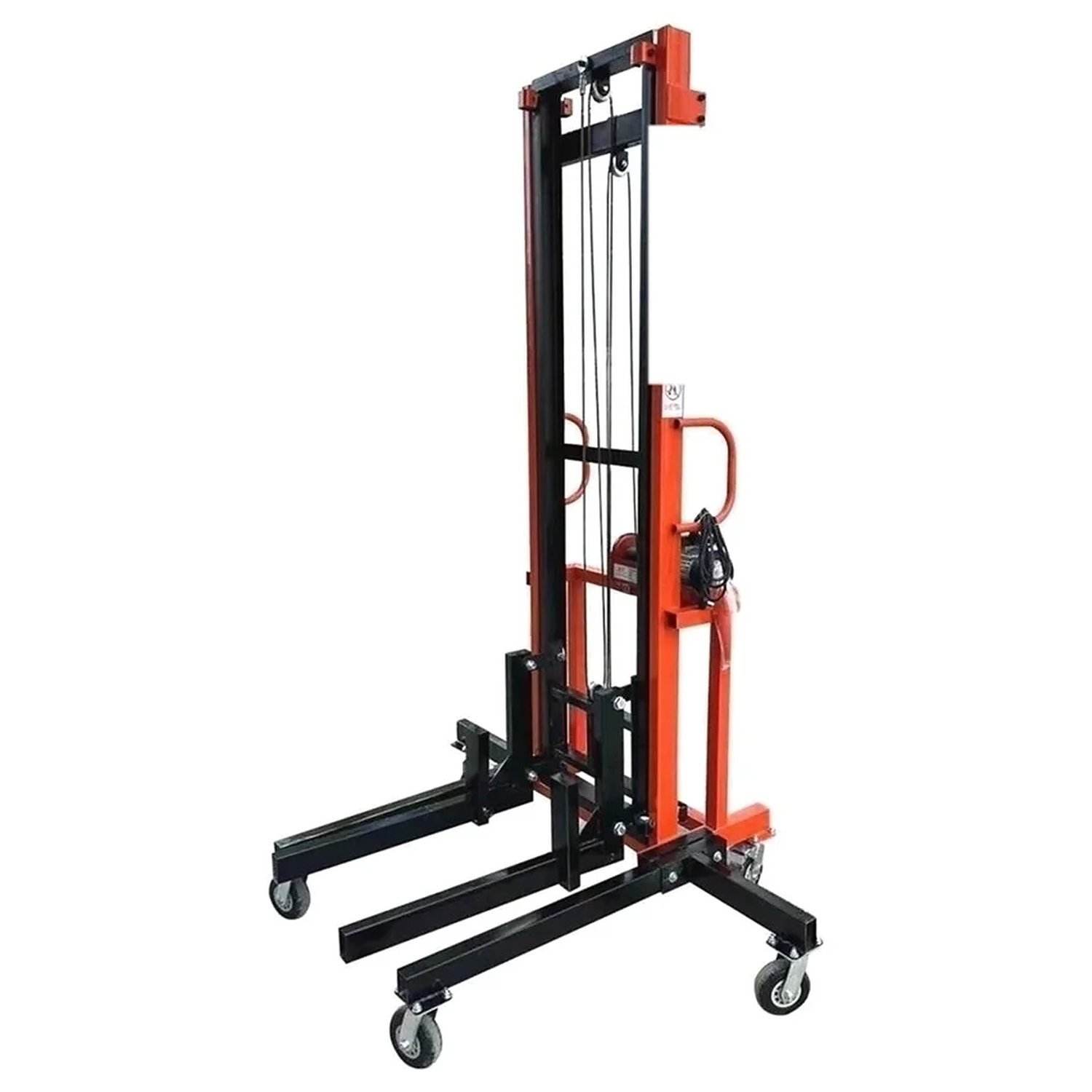
The machine is a two-post mast on a wide wheeled base, with one horizontal arm on each side. The arms sit under the pipe, the duct section or the coil, the hoist lifts, and the load arrives at height square and level — the operator stays on the floor.
400 kg spread over two arms
Each arm is a steel member running out from the carriage, so a length of pipe or a duct section rests on both instead of on one point. Long goods stay level as they rise, and the load sits close to the mast where the frame is strongest.
2.2 m mast, 4 m raised
The mast stands 2.2 m when the carriage is down, which is low enough to pass through a standard door frame. Raised, the carriage takes the arms to 4 m — a duct run at ceiling level, a mezzanine edge or the underside of a pipe rack.
Copper-motor hoist on wire rope
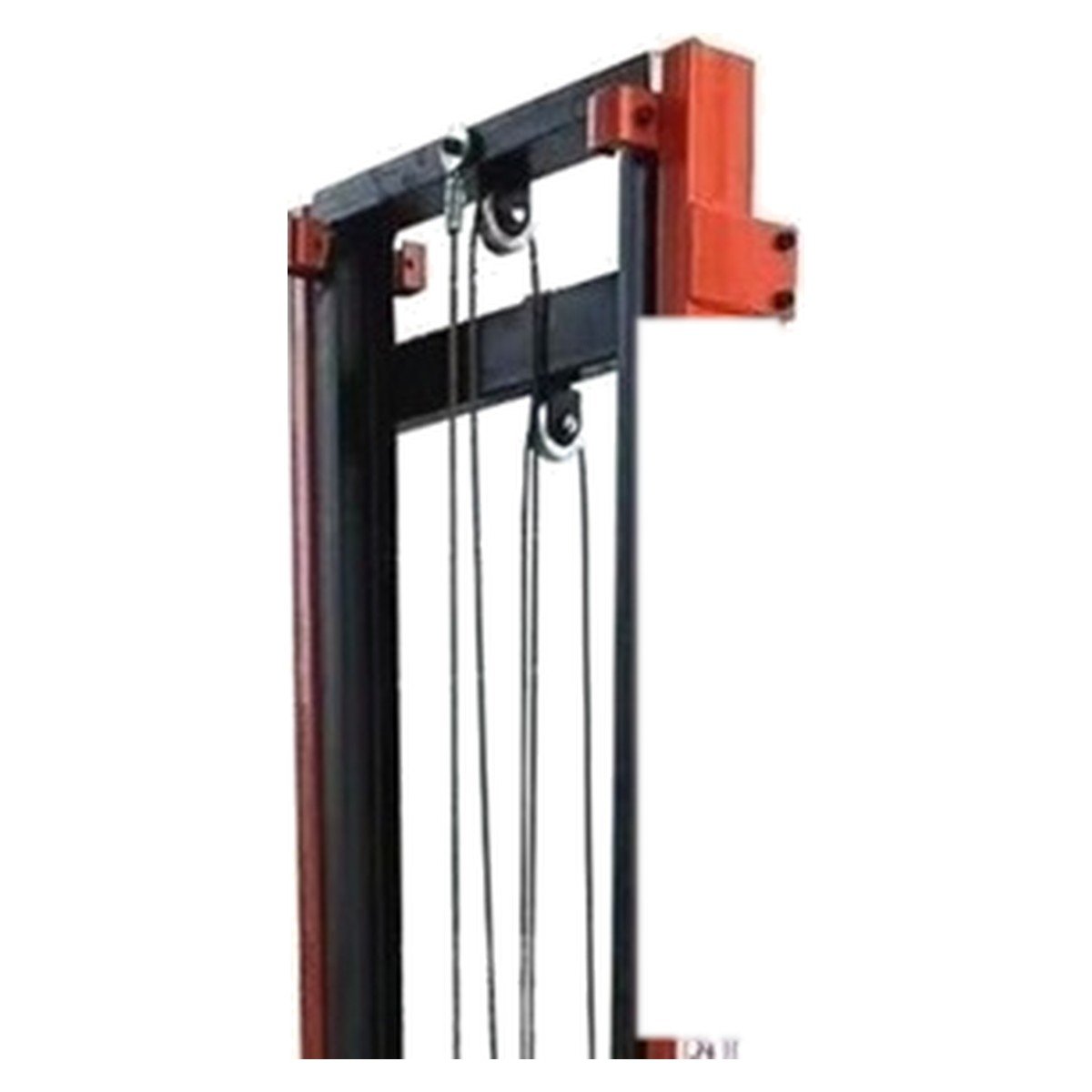
A copper-motor electric hoist lifts on steel wire rope over the top pulley, so the pull runs straight up the mast instead of sideways through the frame. The power cable rides on a reel fixed to the mast, which keeps it off the floor.
1.3 m × 880 mm base on four casters
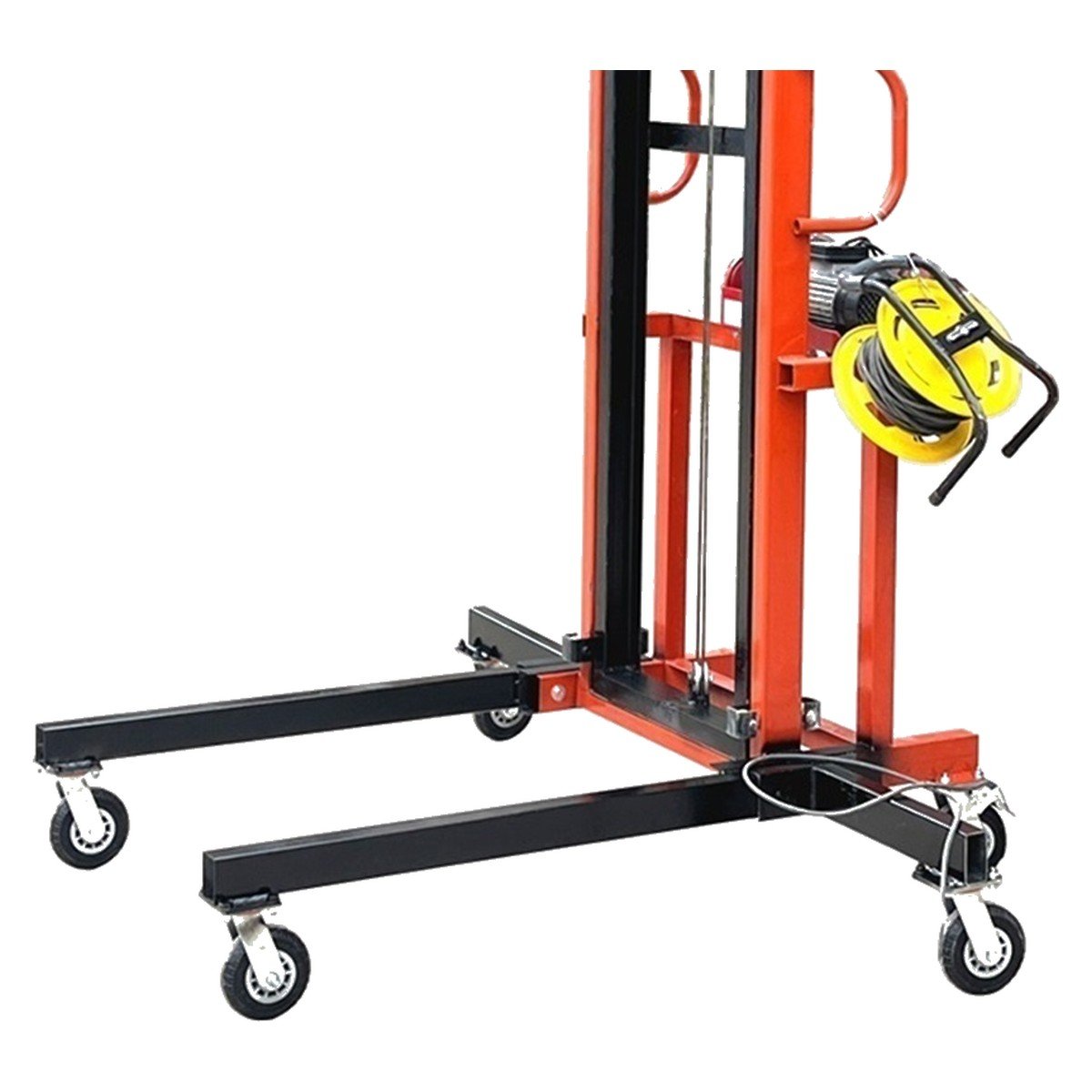
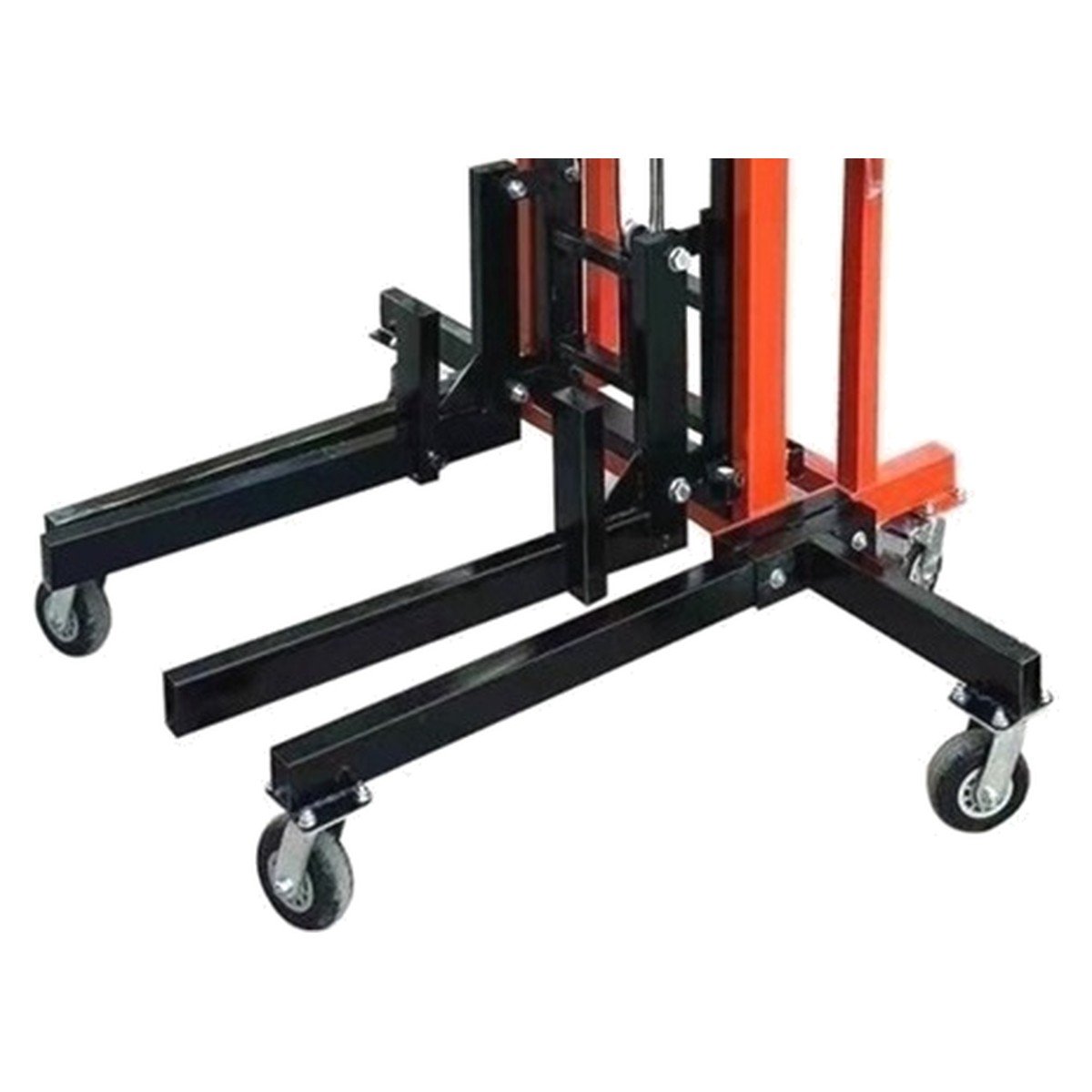
The outriggers open to 1.3 m by 880 mm, wide enough that the machine does not tip when the load is at full height and off centre. Four polyurethane swivel casters, two with brakes, carry it through a door and lock it at the work point.
Double arm electric material lift: technical data
Figures are for the standard build. Ask us for a drawing with the mast height, the footprint and the raised height marked if you need to check the machine against a door frame, a mezzanine or a ceiling run.
Lifting & power
| Lifting mechanism | Two-post mast with a sliding carriage and one horizontal arm each side |
| Drive | Electric hoist — copper motor, steel wire rope over a top pulley |
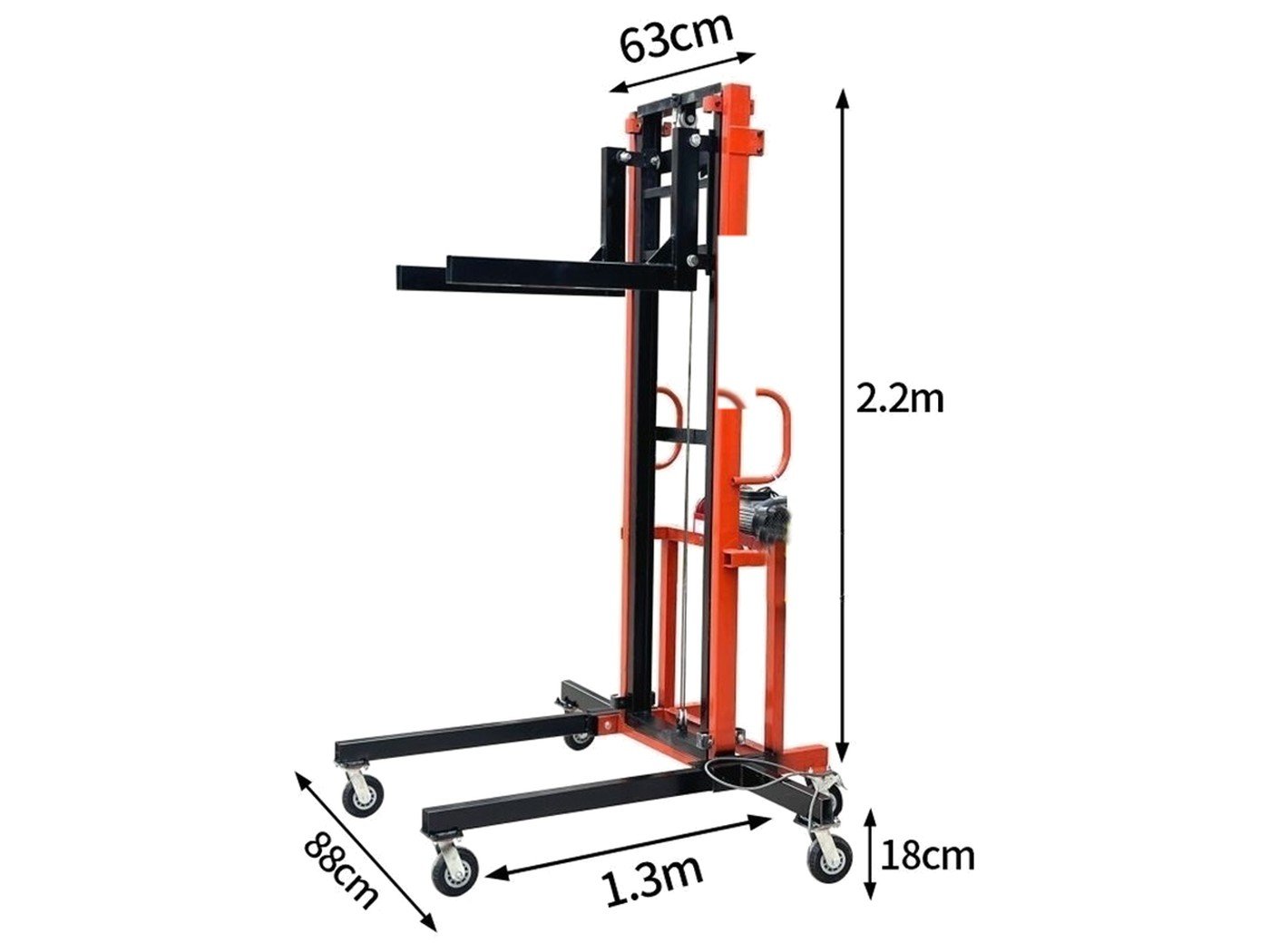
| Lift height | 2.2 m closed, up to 4 m raised |
| Arms | One steel arm each side of the mast, carried on the sliding carriage |
| Power cable | Cable reel mounted on the mast |
| Power supply | Confirmed per destination on the quotation drawing |
Build
| Footprint | 1.3 m × 880 mm with the outriggers open |
| Lowest arm height | 180 mm |
| Top beam | 630 mm across the beam that ties the two posts at the top |
| Overall height | 2.2 m with the carriage down |
| Load capacity | 400 kg |
| Machine weight | About 120 kg |
| Frame | Steel, red; arms and outriggers black |
| Wheels | Four polyurethane swivel casters, two with brakes |
Manually measured dimensions may vary slightly; refer to the actual machine. Load rating, lift height and arm length for a specific build are confirmed on the quotation drawing.
What carries the load, and what lifts it
The mast and its sliding carriage carry the arms; the hoist on the lower frame does the lifting; the outriggers and casters keep the machine on the floor while the load is at the top.
Two posts, 2.2 m, tied by a 630 mm top beam
Two steel posts run the full height and are joined at the top by a 630 mm beam, with a brace part way down. The load hangs between them, so the pull stays inside the frame instead of bending one post away from the other.
The carriage the arms hang from
The arms are bolted to a carriage that runs up and down the mast on rollers. Four wire ropes take the load, so the carriage stays level as it climbs and the arms do not cock to one side under an offset load.
Copper motor at the foot of the mast
The hoist is mounted low on the frame, where its weight helps hold the machine down, and pulls on steel wire rope over the top pulley. The yellow reel beside it carries the power cable and keeps it out of the way of the wheels.
Rope runs straight up the mast
The rope leaves the hoist, runs up the inside of the mast and over the top pulley to the carriage. Because the pull is vertical, the mast takes it in compression rather than in bending — which is why a 120 kg machine can raise 400 kg.
Outriggers open to 1.3 m × 880 mm
The outriggers swing out from the mast foot and pin in place. The wider the spread, the less the machine leans when the load is at 4 m and sits to one side of the mast — measure the spread you get before you plan the route through a doorway.
Four casters, two with brakes
Polyurethane swivel casters roll on a concrete floor and over a workshop threshold. Two of them brake, so the machine can be locked at the work point while the hoist is running and the arms are loaded.
The jobs where the load goes up and the operator stays down
One operator, one machine and the load at height in a single lift: ductwork, pipe runs, coil and sheet goods, and anything else that is too long or too heavy to hand up a ladder.
- Duct and ventilation installationA duct section goes up between the arms and is raised to the ceiling grid, where it can be pushed across onto hangers while the installer works from a step or a platform.
- Pipe runs and pipe racksLengths of pipe rest on both arms and rise level, so the run stays straight as it goes up to the rack — no one holding one end at head height.
- Coils, sheet and panel goodsA coil or a stack of sheet sits across the arms and is lifted to the feed height of a press or a shear instead of being walked up a ramp.
- Warehouse, workshop and siteThe footprint is small enough to move between racks and through a door, so the same machine serves a store, a fabrication bay and a fit-out.
Custom options on this double arm lift
The 400 kg build with a 2.2 m mast and 4 m of lift is the standard machine. When the load is heavier, longer or has to reach higher, the same mast and hoist are built to your drawing.
- Load rating400 kg is standard. A heavier rating is built with a thicker mast section and a larger hoist.
- Lift height2.2 m closed and 4 m raised is standard. A taller mast can be built where the ceiling allows it.
- Arm length and typeThe standard arms take pipe, duct and coils. Longer arms, a flat plate or a cradle for round goods can be fitted for a specific load.
- Frame colour and your logoRed frame with black arms is standard. A specified colour and your logo can be applied before the machine leaves the factory.
Freight is quoted separately and confirmed before dispatch
We ship worldwide by sea (LCL and FCL) and by air or express for sample orders. Freight is priced per destination because it depends on port, weight and volume — this machine ships as one crate on a pallet.
-
You place the order online
Your order is recorded and the machine is reserved for you while the freight is quoted.
-
We send a freight quote in 24–48 hours
Priced to your nearest port, with transit time, or to your door as DDP if you prefer.
-
You confirm and pay the freight
One invoice for the shipping cost. Nothing is dispatched until you approve it.
-
We book, load and send documents
Packing list, commercial invoice and bill of lading go to your email, with photos of the packed goods.
Frequently asked questions
How high does it lift?
How much can it carry?
What can it lift?
How is it powered?
Does it move on its own?
How much floor does it take?
How low does it go?
What does it cost, and how is freight worked out?
Other models built for the same lifting job
Same factory and the same spare-parts support. Choose by load, lift height, and whether the machine has to carry a person or only the goods.

Self-Propelled Scissor Lift Platform 4 m
When the person has to go up with the work: a platform with guardrails that drives and lifts itself to 4 m.
View product →

Fixed Electric Scissor Lift Platform
When the lift point never moves: a 1300 × 820 mm platform on a fixed base, 305 to 1780 mm.
View product →

Cold Storage Panel Lift 4.5 m
For flat panels against a wall or a ceiling: a single mast that holds a panel square while it goes up.
View product →
For materials handling equipment used in general industry, see OSHA 29 CFR 1910.176 on materials handling and storage.
Reviews
There are no reviews yet.